




On August 21, the 29th Chengdu International Automobile Exhibition will officially open at the Western China International Expo City.
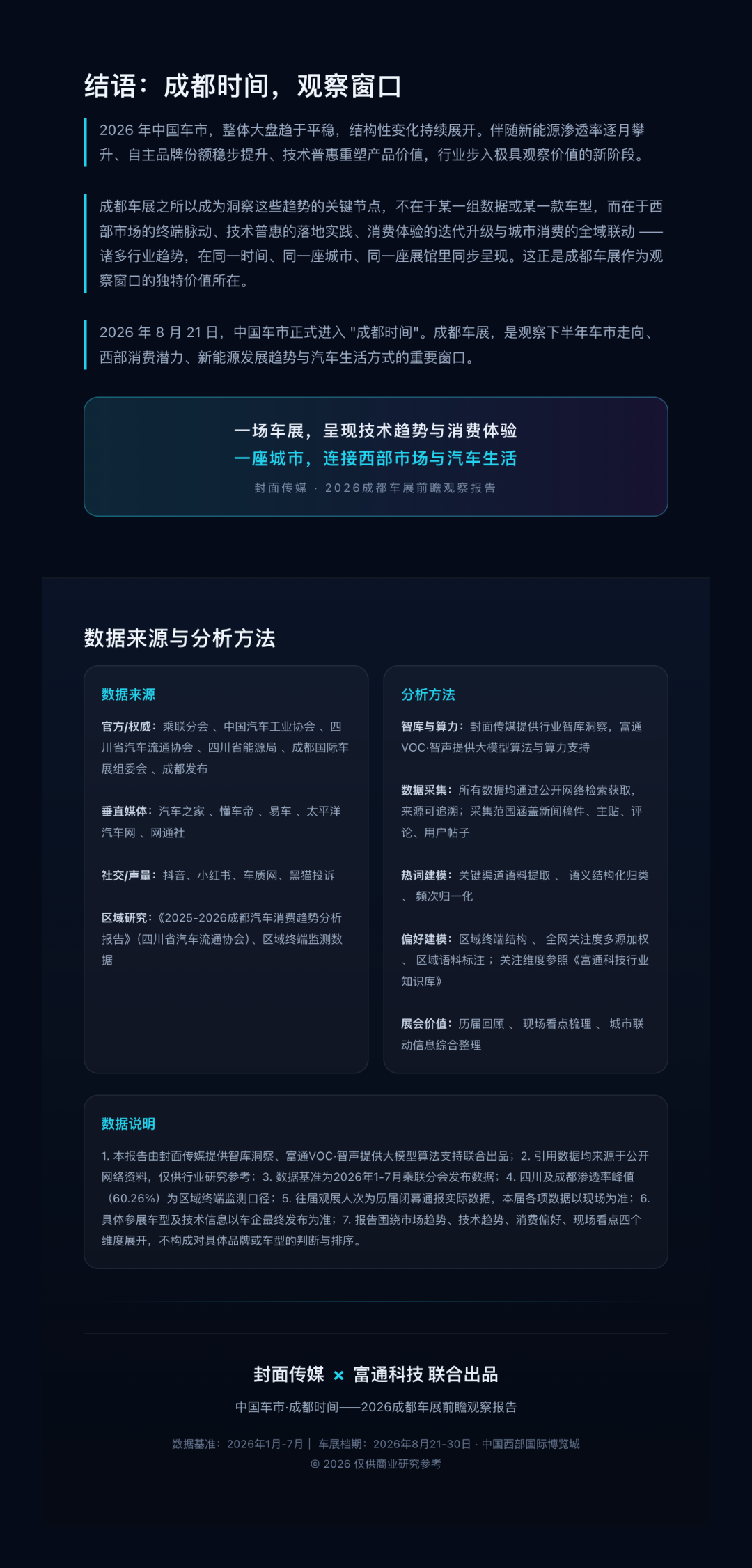
Following the press conference held on August 11, the 2026 Chengdu Auto Show Outlook Report, jointly developed by Cover Media, the Chengdu International Auto Show Organizing Committee, and Futong Technology, was officially released. Based on data from the China Passenger Car Association, China Association of Automobile Manufacturers, Sichuan Automobile Circulation Association, as well as full-network text algorithmic analysis conducted by Futong VOC · Zhisheng Large Model, this in-depth report provides a data-driven outlook on the development trajectory of the automotive industry in Chengdu and across Western China.
This also marks the first time in the 29-year history of the Chengdu International Automobile Exhibition that a comprehensive report on Chengdu’s automotive industry and consumer market has been released.
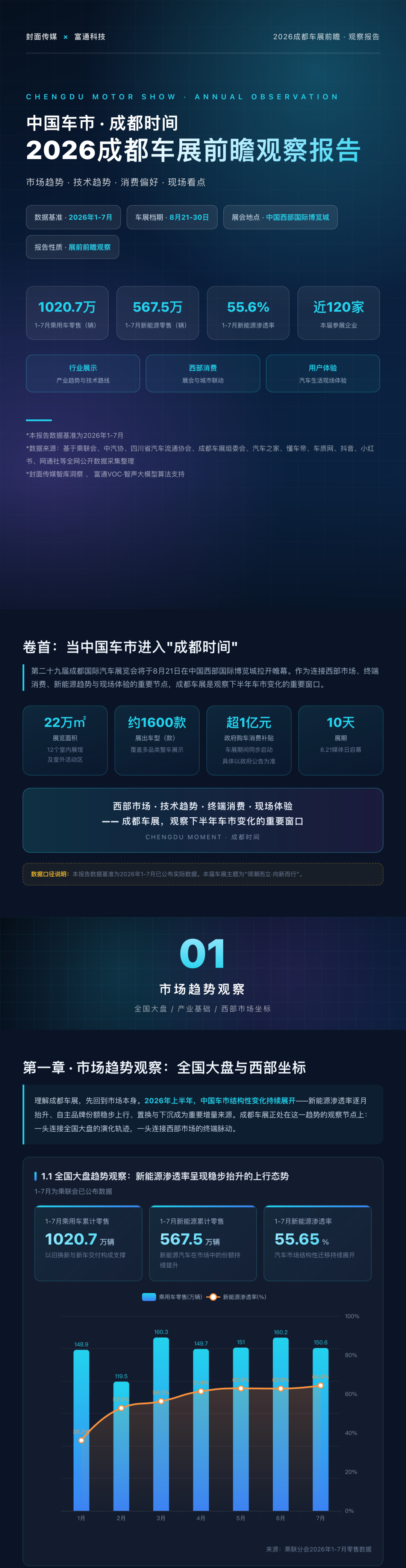
As the first A-level auto show in China to kick off in the second half of the year, the Chengdu Auto Show not only represents the industry scale of nearly 120 participating companies, a 220,000-square-meter exhibition area, and approximately 1,600 vehicles on display. Its theme, “Lead the Trend, Embrace the New,” also reflects the major transformation currently sweeping across China’s automotive industry, with the western market emerging as a core anchor point of this wave.
From January to July this year, China’s passenger vehicle market underwent profound structural shifts. According to data from the China Passenger Car Association, nationwide passenger vehicle retail sales totaled 10.207 million units in the first seven months, including 5.675 million new energy passenger vehicles. The cumulative penetration rate of new energy vehicles rose to a historic 55.65%. On a monthly basis, the penetration rate of new energy vehicles fluctuated upward from 36.2% in January, reaching a record high of 64.4% in July. Against this broader market backdrop, the significance of the western automotive market has become increasingly prominent. In core western cities represented by Chengdu, new energy vehicle penetration has remained at a high level of 40% to 60%, with the monthly penetration rate monitored at Chengdu’s local retail terminals exceeding 60% at its peak. As a megacity with more than 8.3 million registered motor vehicles and no vehicle purchase restrictions, Chengdu has seen its new energy vehicle population surpass 2.4 million. This indicates that new energy vehicle consumption in western China has fully moved beyond policy-driven growth toward strong endogenous demand. The large existing base of fuel vehicles available for replacement, combined with high consumer acceptance of new energy vehicles, forms a core source of incremental growth for the automotive market in the second half of the year.
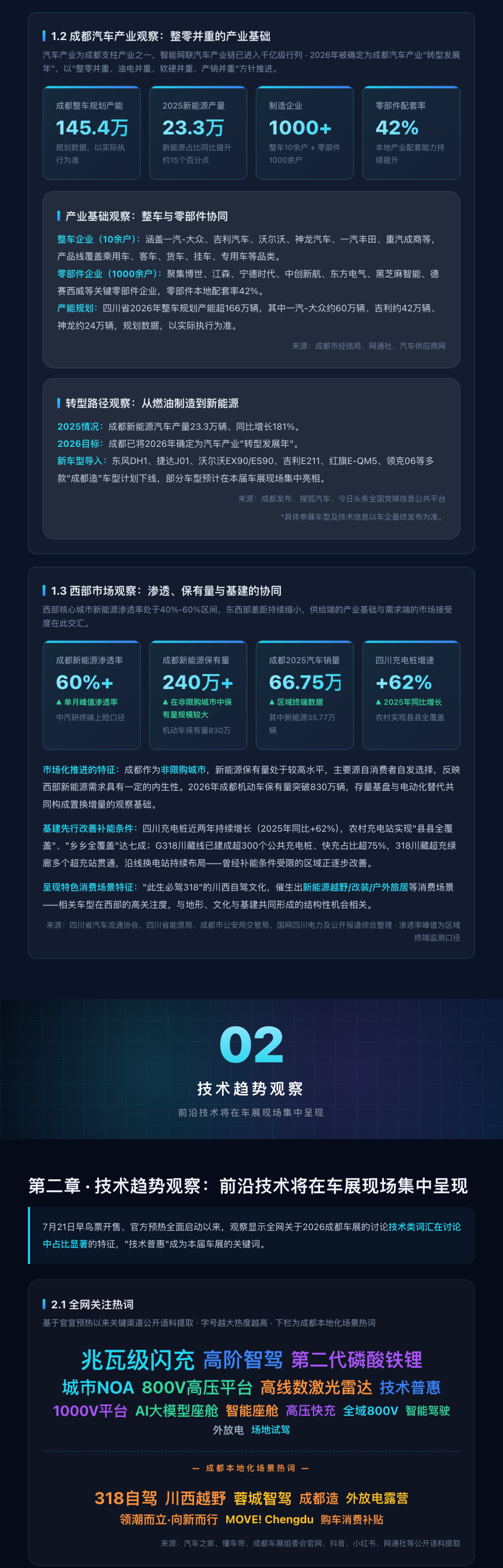
The release of endogenous consumer demand is inseparable from the coordinated evolution of infrastructure and the industrial ecosystem on the supply side. Data shows that the construction of charging facilities in Sichuan Province has accelerated significantly over the past two years, with year-on-year growth reaching 62% in 2025 and more than 70% of rural areas achieving village-level coverage. In particular, the 318 Sichuan-Tibet Route, which is highly characteristic of western China, now has more than 300 public charging facilities, with fast chargers accounting for over 75%. Combined with the connectivity of multiple supercharging and battery-swapping stations, this has significantly alleviated concerns over energy replenishment in high-altitude areas. At the same time, Chengdu’s local industrial supply has demonstrated a high degree of coordination.
As one of Chengdu’s trillion-yuan-level pillar industries, 2026 has been designated as the “Year of Transformation and Development” for Chengdu’s automotive industry. Guided by the 16-character policy of “equal emphasis on complete vehicles and components, fuel and electric vehicles, hardware and software, and production and sales,” Chengdu is home to more than 10 vehicle manufacturers, including FAW-Volkswagen, Geely, Volvo, and Dongfeng Shenlong, as well as more than 1,000 component manufacturers. The local component supply rate has risen to 42%. With a number of new vehicles “Made in Chengdu” from Dongfeng, Jetta, Volvo, Geely, and other automakers making their debut at this year’s auto show, the city’s manufacturing foundation and end-consumer market are achieving increasingly frequent interaction.
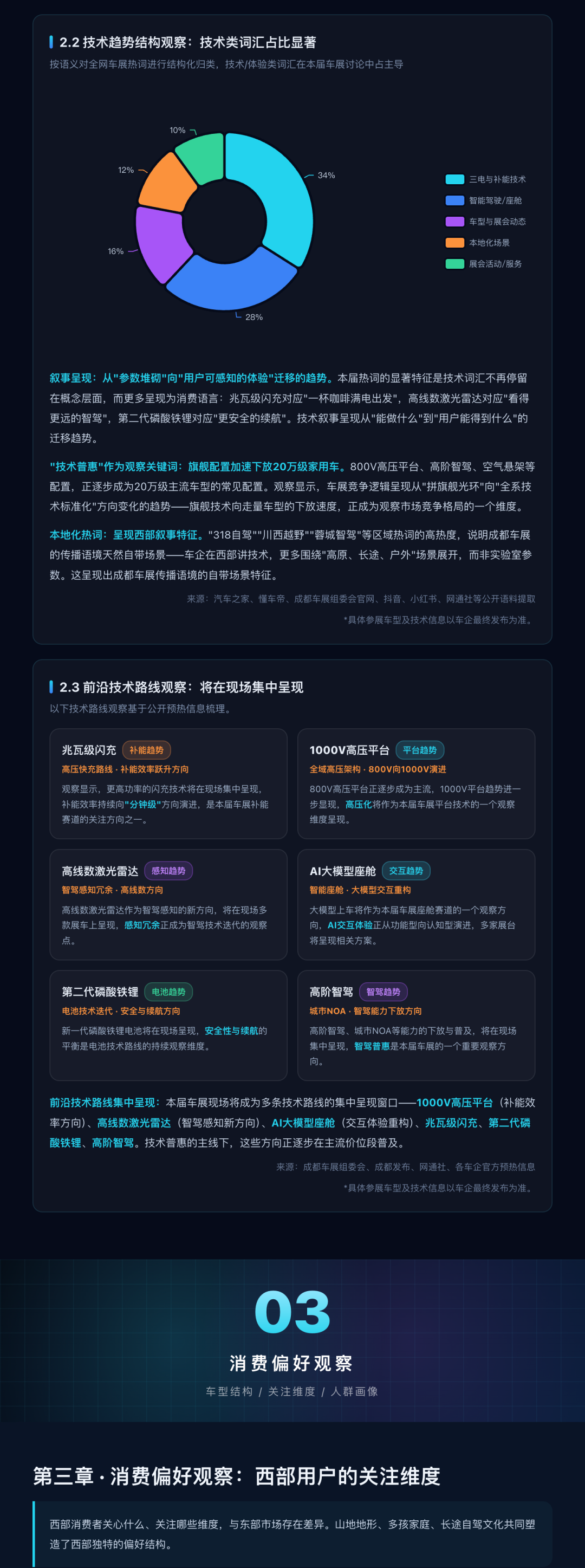
The report shows that in online discussions surrounding this year’s Chengdu Auto Show, technology- and experience-related terms have taken an overwhelming lead. Among them, three-electric-system and energy replenishment technologies account for 34%, while intelligent driving and intelligent cockpits account for 28%, with the two categories together representing more than 60%. Technology-related keywords such as “megawatt-level fast charging,” “1000V high-voltage platforms,” “high-line-count LiDAR,” “second-generation lithium iron phosphate,” and “AI large-model cockpits” rank among the most frequently discussed topics. Configurations once exclusive to flagship models priced in the million-yuan range—including 800V high-voltage platforms, advanced intelligent driving, and air suspension—are increasingly making their way into mainstream family vehicles priced between RMB 150,000 and RMB 200,000. The trend toward technology-driven competition among automakers is becoming increasingly evident at this year’s auto show.
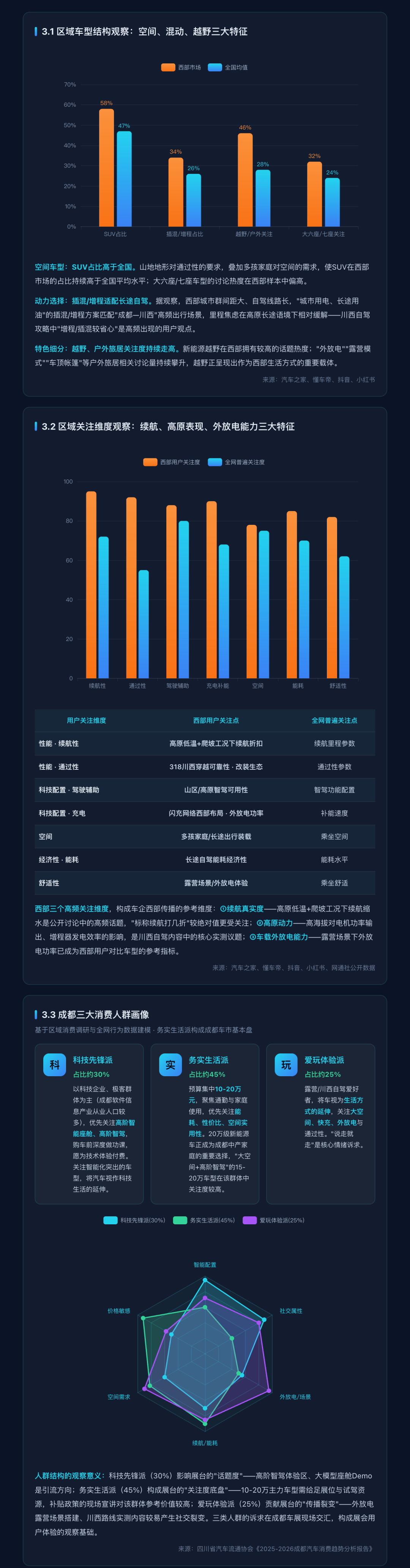
Influenced by geographical conditions, the structure of multi-child households, and a strong culture of long-distance self-driving travel, consumers in western China demonstrate preference patterns that differ significantly from those in eastern China. Comparative data shows that SUVs account for as much as 58% of vehicle-related interest in the western market, compared with a national average of 47%; plug-in hybrid and extended-range electric vehicles account for 34%, compared with a national average of 26%; while interest in off-road vehicles and outdoor activities reaches 46%, compared with a national average of 28%. For consumers in western China, key vehicle considerations center more around “range degradation under high-altitude, low-temperature and uphill driving conditions,” “motor power and range-extender generator efficiency at high altitudes,” and “vehicle-to-load power supply capabilities for camping scenarios.” Based on regional consumer research and full-network behavioral data modeling, Chengdu’s automotive consumers can be broadly divided into three profiles: the “Pragmatic Lifestyle Group,” accounting for 45%, with budgets of RMB 100,000–200,000 and a focus on value for money and spacious interiors; the “Technology Pioneer Group,” accounting for 30%, with a strong preference for advanced intelligent driving; and the “Experience-Seeking Group,” accounting for 25%, with a passion for self-driving trips in western Sichuan. Among these, the Pragmatic Lifestyle Group forms the fundamental consumer base of Chengdu’s automotive market.
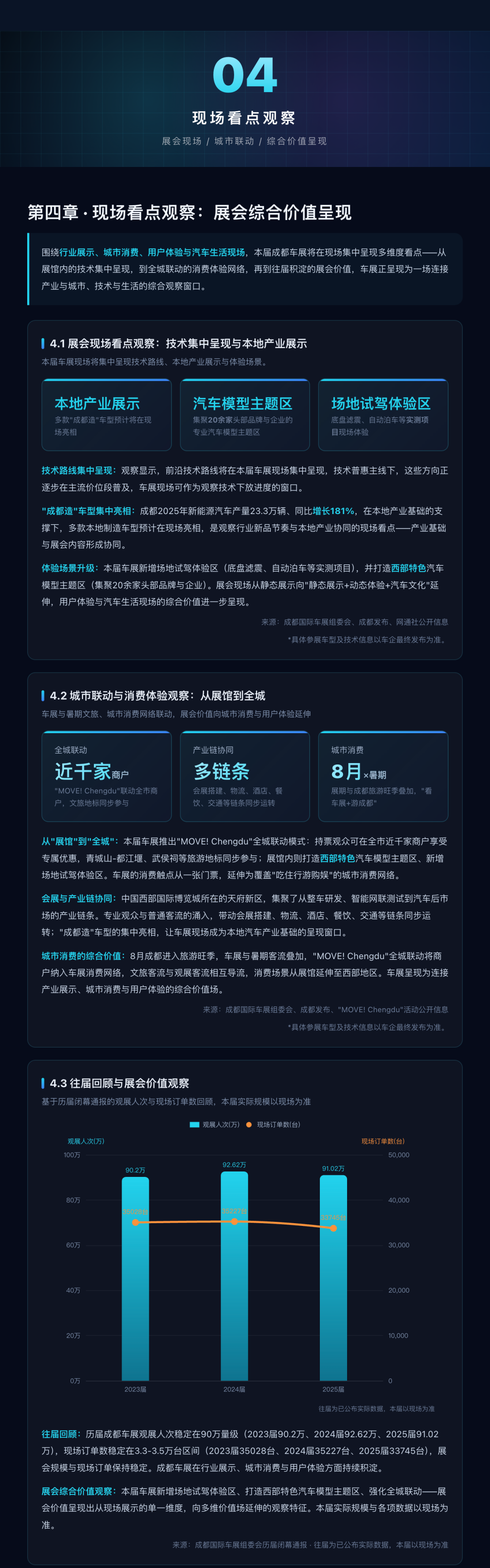
At the same time, this year’s Chengdu Auto Show is demonstrating an urban economic multiplier effect that extends beyond the boundaries of the traditional exhibition venue. In addition to on-site incentives from more than RMB 100 million in government vehicle purchase subsidies, the first-ever automotive model culture museum, and newly added test-drive areas, the auto show has launched the “MOVE! Chengdu” citywide activation model, extending the exhibition economy from Tianfu New Area to nearly 1,000 businesses across the city, as well as cultural and tourism landmarks including Qingcheng Mountain–Dujiangyan and Wuhou Shrine. Historical data shows that the Chengdu Auto Show has maintained more than 900,000 visitors and between 33,000 and 35,000 on-site orders across multiple editions. As the massive exhibition traffic coincides with the peak summer tourism season in August, the Chengdu Auto Show is not only an important window for observing the direction of the automotive market in the second half of the year, but also demonstrates the remarkable resilience and enormous potential of the western consumer market under the integration of the exhibition and the city.
As “Chengdu Time” begins for China’s automotive market, this is more than an annual automotive industry event. It also marks a milestone in the Chinese automotive industry’s evolution toward the broader adoption of advanced technologies and deeper penetration into the consumer market.
(Source: Cover Media | Reporter: Liu Nian)